
The space between the stars
and the things that cross it

“This is where we live; on a blue dot.”
Astrophysicist and science communicator Carl Sagan said this at a NASA press conference in 1990. Around the 57 minute mark. Not essential viewing, though I highly recommend it.
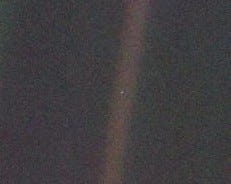
This was the first public display of the famous Pale Blue Dot, a picture of Earth taken billions of miles away by the Voyager 1 space probe. Even at the press conference, Sagan has to look for several moments to find the Earth. The above quote, and the things he said around it, would mature into a large section of his 1994 novel, also titled Pale Blue Dot. One profoundly moving passage of words is one I reread often. And you should too — I will call this essential viewing.
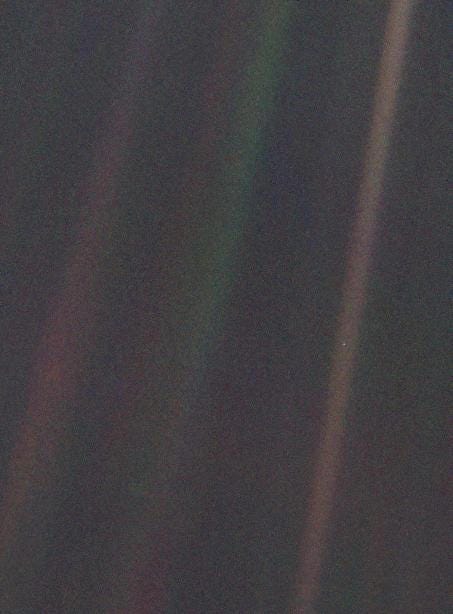
“Look again at that dot. That's here. That's home. That's us. On it everyone you love, everyone you know, everyone you ever heard of, every human being who ever was, lived out their lives. The aggregate of our joy and suffering, thousands of confident religions, ideologies, and economic doctrines, every hunter and forager, every hero and coward, every creator and destroyer of civilization, every king and peasant, every young couple in love, every mother and father, hopeful child, inventor and explorer, every teacher of morals, every corrupt politician, every "superstar," every "supreme leader," every saint and sinner in the history of our species lived there--on a mote of dust suspended in a sunbeam.” — Carl Sagan1
I want to talk about Voyager, and our Pale Blue Dot. To do that, I need to back up. Just to 1965. It won’t be long, I promise.
In 1965, Gary Flandro was a PhD student working at the Jet Propulsion Laboratory (JPL) in Pasadena, California. Four JPL spacecraft had already been sent to Venus and Mars for NASA’s Mariner program.2 The inner solar system was all the rage back then. Scientifically interesting, and just down the block on a cosmic scale.
See, we knew how to build spacecraft to last for a year or two. Anything more was science fiction.3 Sensitive instruments and flight computers couldn’t survive the heat, or the cold, or the vacuum, or the radiation that long. And the inner planets are like ours. Terrestrial. The outer planets — Jupiter, Saturn, Uranus, Neptune — are frozen behemoths of gas and ice. You don’t land on Jupiter, you fall into Jupiter.
Everyone else was busy, so Flandro was the only one looking at flight paths for the outer solar system. And he found something very important. A critical alignment of orbits that would allow a spacecraft to visit not one, but all four gas giants in as little as seven years. That’s fast for space. Moving in space is hard. Keeping enough fuel and power on board to make movement possible is hard. So is visiting one planet on a flyby. Assuming a craft could last long enough to do it, gravity assists would make this four-planet route possible.
A gravity assist is exactly what it sounds like. The gravitational field of a large planet (like Jupiter) can “assist” a much smaller spacecraft (like Voyager) by changing its momentum. With these velocity boosts, a spacecraft could “slingshot” itself between planets.4
Flandro’s 1966 paper laid out multiple flight paths that could be used for outer solar system exploration.5 As Flandro said in an interview in 2022: “If you can reach Jupiter with the right encounter conditions, you can fly anywhere in the solar system or even escape it.”6
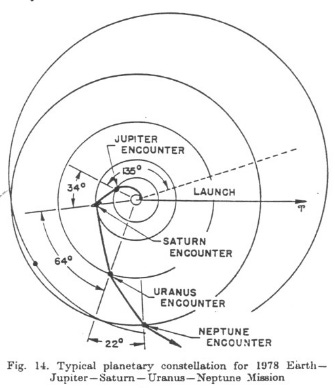
This four-planet mission was dubbed the “Grand Tour” of the planets. Due to the timing of each planet’s orbit, this arrangement only occurs once every 176 years. The next launch window to achieve this was 1977. They had twelve years.
The development of the Voyager mission is as fascinating as it is long. I wrote a lot about it, then realized I deviated wildly from the point of this post. In short, the Voyager program is made of two identical spacecraft. Creatively named Voyager 1 and Voyager 2. These spacecraft would take advantage of the Grand Tour launch window and some of its iterations7 to explore the outer solar system. The secondary goal — hope, rather — was for the Voyager probes to leave the solar system entirely and explore interstellar space. The space between the stars.
During their flight, several requests were made for Voyager to turn around. Either one of them. Not to return, but to look back at the inner solar system. To turn their cameras to their starting point. Home. The requests were denied. The mission came first. After all of this time and money and effort, the mission had to come first. After the Jupiter flyby, they had to focus on Saturn. After the Saturn flyby, they had to focus on Titan, and Uranus, and so on.
It took eight years and seven formal requests for it to happen. After its successful encounters and treasure troves of scientific data — and some significant influence from our friend Carl Sagan — Voyager 1 turned around.
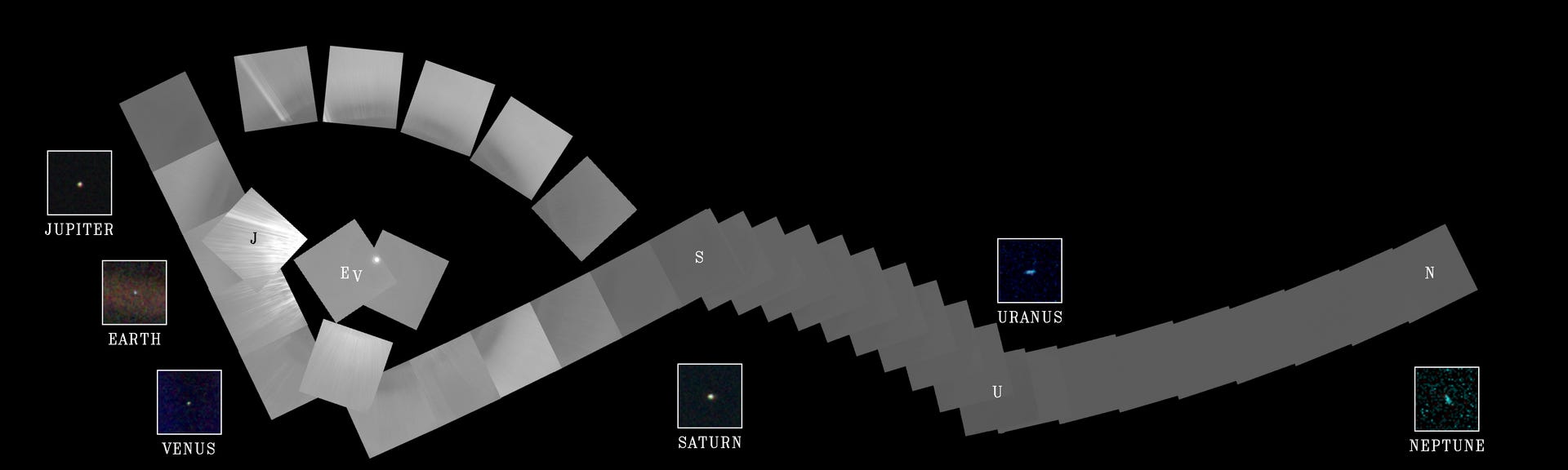
This is a mosaic of 60 pictures,8 taken over the course of one day. The only of its kind. Venus, Earth, Jupiter, Saturn, Uranus, and Neptune, each captured with separate filters and exposure times. Sadly, Mercury and Mars were obscured. We’ll have to try again next time. Of course, the most famous of these pictures is our beloved Pale Blue Dot.
I shared the original photograph, but NASA published a remastered version in 2020.9

When I was a child, I ran away from home. “I have to go,” I told my mom woefully, while I shoved a pencil and a fist full of Cheerios into my backpack. I made it from the front door to the stop sign at the end of the cul-de-sac, and somewhere between the two I realized there were a lot of mosquitoes out. And cereal tasted better with milk. Maybe brushing my teeth wasn’t that bad. The AC cooled the sweat on my face, and my mom welcomed me home.
Voyager wasn’t built to come home. We sent them into the unknown with a rucksack of cameras and sensors and some decaying plutonium to stay warm. We gave them eyes and ears and voices made of ones and zeros. We built ourselves ears to listen to them. We found some really, really smart people to do it.
The last picture in the Family Portrait mosaic is the last Voyager 1 ever took. To save power for the trip ahead, its cameras were powered down. As of 2026, we’re still communicating with both Voyager probes. It takes almost a day one way for the signals to travel, but we still get them, and we still send our own back. With half of their instruments turned off or broken, the Voyagers are still talking to us, and scientists are still using them to understand the universe.
Voyager 2 entered interstellar space on August 25th, 2012. The first human-made object to ever do it. The furthest a human-made object has ever gone, and still going.10
On February 21st, 2013, a less famous picture was taken. The Very Long Baseline Array (VLBA) is not in one place, but ten. It’s a constellation of telescopes, from Mauna Kea to Los Alamos to Green Bank to St. Croix, that use some elegant physics to operate as “one” large telescope.11 In honor of Voyager 1’s interstellar crossing, the VLBA captured this image:12
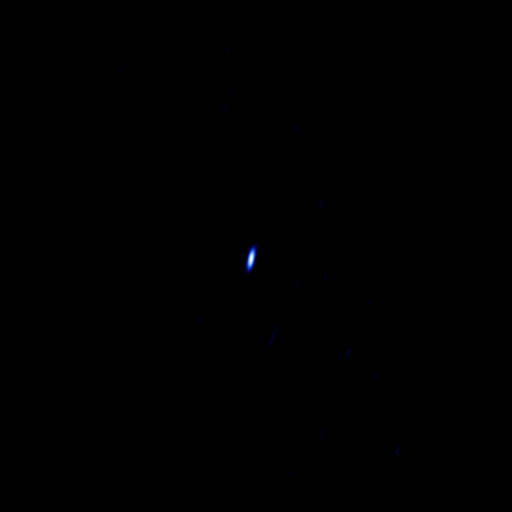
This is Voyager 1’s radio signal. Sent by its 22-watt transmitter, over 11 billion miles away. 22 watts is about how much light your fridge spits out when you open it. The VLBA is a very strong telescope, and thankfully, 22 watts is pretty loud in the background of space. It’s not quite as pale, and it’s a little long to be a dot, but the similarity is unavoidable.
Each Voyager holds a golden record. The Golden Record. An entire new essay could be written to explain its design and how it was made. But at its core, the record is a primer. It plays over fifty greetings in over fifty languages; it plays sounds of animals, and laughter, and liquid water, and wind in a 78 percent nitrogen atmosphere. It plays music and can display pictures — over a hundred, unique in all the worlds.13
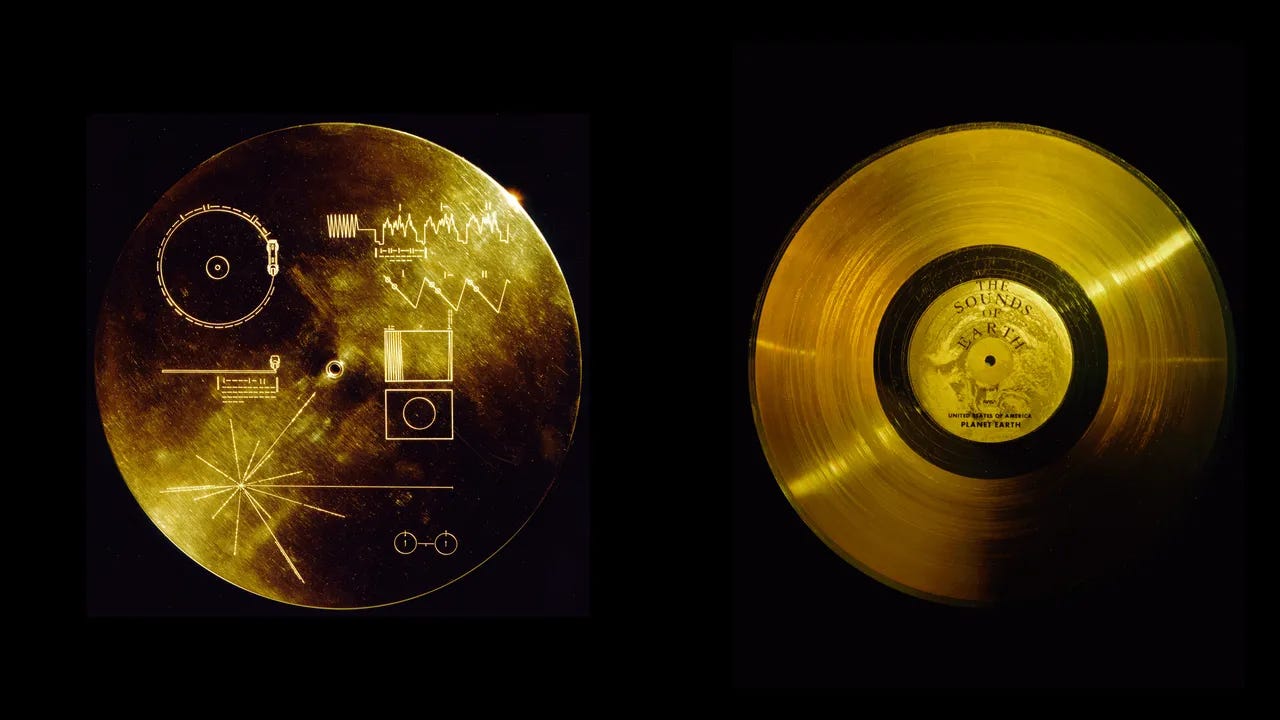
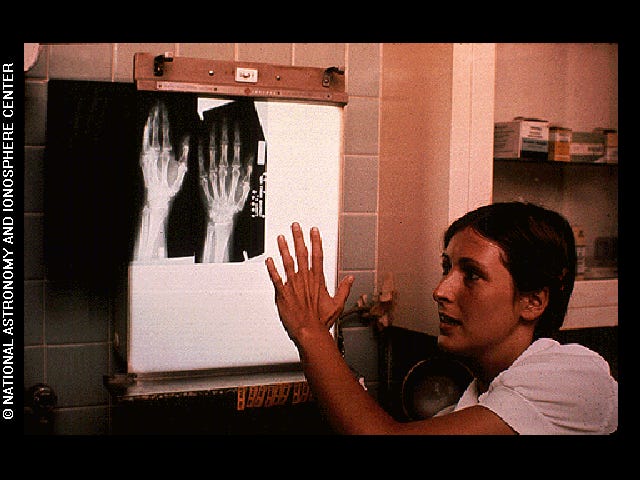
It’s a hello. A “Halvdan carved these runes” etched into marble eleven hundred years ago.14 It’s the Nazca lines.15 Hand prints on ancient cave walls that look so, so much like ours. We can hold our own up side by side, waving to someone who existed ten thousand years ago. And in ten billion years when the Earth has been swallowed by a bloated and dying sun, the records will be okay. The gold plated copper is pretty, and it’s strong.

Sagan was right, of course; we do live on a pale blue dot. When this one is gone, the smaller two we sent out in our stead will still be there. The best of ourselves we saw fit to share, drifting like a seed on the wind.
“This is a present from a small distant world, a token of our sounds, our science, our images, our music, our thoughts, and our feelings. We are attempting to survive our time so we may live into yours.” — Excerpt of text from Jimmy Carter, contained on the Golden Record.16
So, from one pale blue dot to another: Hi. How are you? We’re proud of you. We hold the best of you with us. We love you.
The original Pale Blue Dot photograph was taken on February 14th, 1990. Happy (belated) Valentine’s Day.
Later, Mercury would join the list with the Mariner 10 mission. I’ll need to make a post for Mariner 10 alone. It’s a fascinating story.
Obvious in hindsight, but landing on the Moon was also science fiction. And we did, four years later.
Mariner 10 would become the first mission to demonstrate the gravity assist in 1974, but in the 60s, the theory was sound. God, I could talk about Mariner 10 all day. See Footnote 2.
“Fast Reconnaissance Missions to the Outer Solar System Utilizing Energy Derived from the Gravitational Field of Jupiter.” Again, not essential viewing, but it is quite interesting.
In the 70s, scientists really, really wanted to fly by Saturn’s Earth-like moon, Titan. It was a strong candidate for extraterrestrial life. A Jupiter-Saturn-Titan flight path became the priority for the Voyager program. Jupiter, Saturn, Titan, Uranus, and Neptune couldn’t be reached by one spacecraft on one flight; as with many cool things, the physics wouldn’t allow it. So Voyager 1 would take the Jupiter-Saturn-Titan trajectory, and Voyager 2 would be a contingency plan. If Voyager 1 was a success, Voyager 2 would complete the Jupiter-Saturn-Uranus-Neptune trajectory, the “full” Grand Tour. This arrangement meant that Voyager 2 would launch 2 weeks before Voyager 1 — Voyager 2 would start its Grand Tour, but with enough time to course correct if Voyager 1 was compromised between Jupiter, Saturn, and Titan. Or earlier. Or if it was lost during launch by a compromised rocket. Or if a freak earthquake struck Florida and destroyed it. There are a lot of things that can go wrong between point A and point B.
NASA publishes Voyager status updates in real time. I get chills every time I look at this. It’s a fun version of the “United States Debt counter” my civics teacher showed us in high school.
https://en.wikipedia.org/wiki/Very_Long_Baseline_Array. Telescope names are incredibly funny. The Very Long Base Array. The Karl G. Jansky Very Large Array (VLA). in New Mexico. The Very Small Array (VSA) in the Canary Islands. It’s what they say on the tin.
https://goldenrecord.org. Best viewed on a desktop, if you can.
https://en.wikipedia.org/wiki/Runic_inscriptions_in_Hagia_Sophia. The exact translation of the Halvdan carving is debatable, but the intent is there, and very compelling.
The intersection of science writing and poetry. Both are ways to investigate the deep questions and meanings of our existence, and the fact that this essay does /both/ well is so impressive. What a joy to read (even if it did make me cry).
Lovely as alwayz